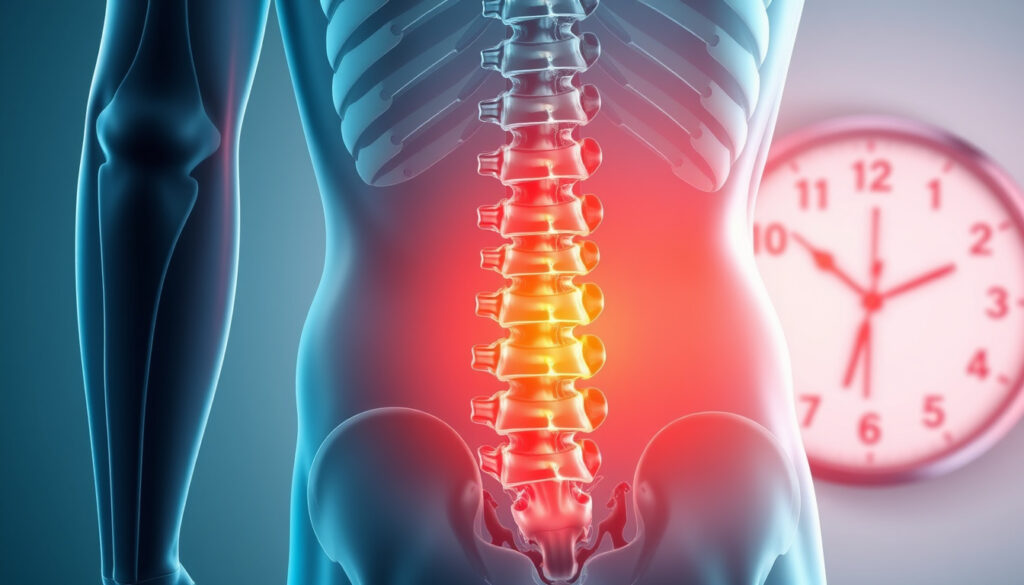
Pain in Lower Back Causes: Red Flags, Relief, and When to Worry
Few things stop you in your tracks like a sudden twinge in the lower back — and if you’ve ever had one, you know the worry that follows. Most of the time it’s just a pulled muscle or a stiff joint, but sometimes the cause is more serious.
Lifetime prevalence of low back pain: Approximately 80% of adults experience it at some point ·
Global disability rank: Single leading cause of disability worldwide (GBD 2020) ·
Typical duration of acute episode: Resolves within 4-6 weeks for most ·
Chronic low back pain definition: Pain lasting longer than 12 weeks
Quick snapshot
- Muscle strain — the most frequent cause (Mississippi Spine Institute (orthopedic clinic))
- Disc degeneration related to aging (Johns Hopkins Medicine (academic medical center))
- Cauda equina syndrome requires emergency surgery (Orlando Orthopaedic Center (orthopedic practice))
- Unexplained weight loss + back pain raises concern for malignancy (Atlanta Spine Institute (specialty spine clinic))
- Ice first 48 hours, then heat (NHS (UK national health authority))
- OTC NSAIDs like ibuprofen reduce acute pain (NHS (UK medicines guide))
- Pain lasting more than 6 weeks (Consultant360 (clinical review platform))
- Neurological symptoms like leg weakness or numbness (NeuroSpinePlus (spine care center))
Five key figures, one pattern: the vast majority of low back pain is mechanical and self-limiting, but a small percentage demands urgent medical attention.
| Label | Value |
|---|---|
| Lifetime prevalence | 80% of adults |
| Most common cause | Muscle or ligament strain |
| Serious underlying cause rate | <5% |
| Average recovery time (acute) | 4–6 weeks |
| Most effective self-care | Staying active, avoiding bed rest |
What are 5 red flags of low back pain?
Identifying red flags early can separate a routine strain from a life-threatening emergency. The American College of Emergency Physicians (leading emergency medicine organization) emphasizes that trauma, coagulopathy, and immunosuppression are major risk factors for serious causes.
Red flag 1: Cauda equina syndrome
- Bowel or bladder dysfunction, saddle anesthesia, and progressive bilateral leg weakness are classic signs. Orlando Orthopaedic Center (orthopedic practice) notes that urinary retention occurs in up to 90% of cases.
- Immediate surgical decompression is required to prevent permanent paralysis.
Red flag 2: Recent trauma or fracture
- High-energy injuries (falls, car accidents) or low-energy fractures in osteoporotic bone are red flags. ACEP lists major trauma as a classic red flag.
Red flag 3: Unexplained weight loss or fever
- Weight loss combined with back pain raises suspicion for malignancy or infection. Atlanta Spine Institute (specialty spine clinic) includes unexplained weight loss among red flags.
- Fever suggests spinal infection (osteomyelitis, epidural abscess).
Red flag 4: History of cancer
- One of the most consistently cited red flags. Consultant360 (clinical review platform) notes that a cancer history is a key warning sign.
Red flag 5: Progressive neurological deficits
- Foot drop, saddle anesthesia, or loss of rectal tone are emergencies. NeuroSpinePlus (spine care center) highlights saddle anesthesia as a classic sign.
How to relieve lower back pain fast?
When pain hits, you want relief that works within minutes to hours. The NHS (UK national health authority) recommends staying active rather than resting in bed.
Ice and heat therapy
- Apply ice packs for 15–20 minutes every 2–3 hours during the first 48 hours to reduce inflammation. After that, switch to a heating pad or warm bath to relax tight muscles.
Over-the-counter pain relievers
- NSAIDs such as ibuprofen (Advil, Motrin) effectively lower inflammation. NHS (UK medicines guide) confirms their use for acute back pain.
- Acetaminophen (Tylenol) can help if NSAIDs are contraindicated, though evidence is weaker.
Gentle movement and stretching
- Light walking or gentle cat-cow stretches prevent stiffness. Avoid heavy lifting, twisting, or high-impact exercise.
Sleep posture adjustments
- Sleeping on your side with a pillow between your knees keeps the spine aligned and reduces strain on the lower back.
Avoid prolonged bed rest
- HSE Ireland (Irish health authority) advises that too much bed rest can delay recovery. Stay as active as pain allows.
How can I tell if my lower back pain is serious?
Most back pain resolves on its own, but certain patterns signal trouble. Consultant360 notes that serious causes account for less than 5% of cases.
Watch for red-flag symptoms
- Bowel/bladder dysfunction, fever, unexplained weight loss, or night pain that doesn’t subside with rest.
Duration and intensity patterns
- Acute pain that lasts longer than 6 weeks warrants medical evaluation.
- Pain that is worse at night or unrelieved by rest is suspicious for tumor or infection.
Nerve-related symptoms
- Radiating pain below the knee (sciatica) suggests nerve root compression.
- Numbness, tingling, or weakness in one or both legs.
When to visit a doctor
- If any red flag is present, if pain interferes with daily function for more than a week, or if you have a history of cancer, osteoporosis, or recent trauma.
Diagnostic imaging considerations
- X-rays and MRIs are not routinely needed for uncomplicated back pain. ACEP (emergency medicine organization) recommends imaging only when red flags are present.
Over 70% of patients referred for early MRI get scans that show age-related changes that are incidental — not the cause of pain. Unnecessary imaging can lead to overtreatment and anxiety.
What organ could cause lower back pain?
Sometimes the pain isn’t coming from the spine at all. Visceral organs can refer pain to the lower back, making diagnosis tricky.
Kidney conditions (stones, infection)
- Kidney pain is typically felt in the flank (side of the lower back) and may radiate to the groin. Fever and painful urination often accompany infection.
Pancreatic disorders
- Acute pancreatitis can cause deep, epigastric pain that bores through to the middle back.
Abdominal aortic aneurysm
- This life-threatening condition may present with sudden, severe, throbbing low back or abdominal pain. The Sullivan Group Blog (medicolegal risk management) lists AAA as a critical diagnosis not to miss.
Reproductive organs (ovaries, uterus, prostate)
- Endometriosis, ovarian cysts, and pelvic inflammatory disease can refer pain to the lower back. In men, prostatitis may cause low back and perineal discomfort.
Gastrointestinal issues (diverticulitis)
- Diverticulitis often causes left-sided lower abdominal pain that can radiate to the lower back, especially in older adults.
What are the big 3 for lower back pain?
The McGill Big 3 are three exercises designed to build spine stability and reduce recurrence. Developed by Dr. Stuart McGill (world-renowned spine biomechanics researcher), they target the core muscles without stressing the spine.
1: McGill curl-up
- Lie on your back with one leg straight, one knee bent, hands under your lumbar spine. Lift your head and shoulders just a few inches without flexing the spine. Hold for 10 seconds. Dr. McGill’s BackfitPro site details proper form.
2: Side bridge
- Lie on your side, propped on your elbow, feet stacked. Lift your hips to form a straight line from shoulders to ankles. Hold for 10–15 seconds per side.
3: Bird-dog (quadruped hip extension)
- Start on hands and knees. Simultaneously extend your right arm and left leg, keeping your back flat. Hold for 5 seconds, then switch sides.
Performed daily, these exercises reduce recurrence risk significantly. Research in the Journal of Orthopaedic & Sports Physical Therapy confirms that motor control exercises like the Big 3 reduce low back pain recurrence.
The Big 3 are not for acute pain — they’re a maintenance program for people whose acute episode has resolved. Attempting them during severe flare-ups can worsen pain.
Step-by-Step: How to Perform the McGill Big 3 for Lower Back Pain
- Start slow: Perform each exercise with a 10-second hold, 5 reps per side, once daily.
- Maintain neutral spine: Keep your back flat — no sagging or arching.
- Breathe steadily: Exhale on exertion, inhale during hold.
- Progress gradually: Increase hold time to 15–20 seconds over 2–3 weeks.
- Stop if sharp pain occurs: If you feel anything beyond mild muscle fatigue, stop and consult a physical therapist.
Confirmed facts vs. What’s unclear
Confirmed facts
- Red flags for serious back pain are well-established and consistent across guidelines.
- NSAIDs and heat/ice are effective first-line treatments for acute pain.
- The McGill Big 3 exercises reduce recurrence risk when performed correctly.
- Organ-related back pain (kidney, pancreas, AAA, reproductive) is less common but identifiable with careful history and imaging.
What’s unclear
- Exact prevalence of organ-related back pain in primary care settings is not well documented.
- Optimal duration of specific exercise programs (like the Big 3) for chronic pain has limited high-quality evidence.
- Gender-specific incidences of certain causes — for example, how fibromyalgia versus disc degeneration differs between men and women — remain poorly studied.
Expert perspectives on lower back pain
“The majority of low back pain episodes are mechanical and self-limiting. The key is to avoid unnecessary imaging and to focus on active management.”
Cleveland Clinic (leading academic medical center)
“If you have cauda equina symptoms — saddle anesthesia, bladder dysfunction — don’t wait. Go to the emergency room immediately.”
NHS (UK national health authority)
“Spinal degeneration is a normal part of aging. Most people over 50 have some disc narrowing or arthritis on MRI, and most of them have no pain.”
Johns Hopkins Medicine (academic medical center)
“Staying active within pain limits is the single most effective self-care strategy. Bed rest for more than two days weakens the muscles and delays recovery.”
HSE Ireland (Irish health authority)
The message for anyone experiencing lower back pain is clear: stay active, treat acute pain with ice and NSAIDs, and recognize the rare red flags that demand urgent care. For the vast majority, the body heals within weeks. For those with recurrent episodes, the McGill Big 3 offers a proven path to stability. For patients over 50, the risk of serious pathology increases, but even then, most back pain remains mechanical. The takeaway: don’t ignore pain, but don’t let fear drive you into unnecessary scans or surgery. Your first line of defense is movement, ice, and time.
Related reading: Red Flags and Emergency Causes of Lower Back Pain
Frequently asked questions
What causes lower back pain in females?
In addition to the common causes (strain, disc degeneration, arthritis), females may experience back pain related to endometriosis, ovarian cysts, pregnancy-related ligament strain, and fibromyalgia — conditions that refer pain to the lower back. Women’s Health (U.S. federal women’s health resource) notes that pelvic floor disorders can also contribute.
What causes lower back pain in males?
Common causes in men include mechanical strain, disc herniation, and degenerative changes. Prostatitis (prostate inflammation) and referred pain from the kidneys or gastrointestinal tract can also cause lower back discomfort. NHS (UK health authority) lists prostatitis as a potential source.
How can I cure my lower back pain long-term?
There is no single “cure,” but a combination of regular exercise (especially core strengthening like the McGill Big 3), proper ergonomics, weight management, and avoiding prolonged sitting can prevent recurrence. Research shows that motor control exercises significantly reduce the risk of recurrence.
What causes sudden lower back pain without injury?
Sudden pain without trauma is often due to a muscle spasm or acute disc herniation. In some cases, visceral causes like kidney stones (colicky flank pain), acute pancreatitis, or abdominal aortic aneurysm can present as sudden lower back pain. The Sullivan Group Blog (medicolegal risk management) emphasizes not overlooking aortic aneurysm.
What causes sudden severe lower back pain that prevents walking?
Severe pain that prevents walking can be due to a large disc herniation compressing the spinal cord or cauda equina, spinal fracture, epidural abscess, or acute lumbar radiculopathy. This is a medical emergency — seek immediate evaluation. Orlando Orthopaedic Center (orthopedic practice) lists inability to walk as a red flag.
Can lower back pain be a sign of kidney problems?
Yes. Kidney stones typically cause sharp, colicky flank pain that radiates to the groin. Kidney infection (pyelonephritis) causes dull ache with fever and painful urination. The pain is usually felt on one side of the lower back rather than midline. NHS (UK health authority) describes the typical location and nature of kidney stone pain.
Is it safe to exercise with lower back pain?
It depends on the cause. For acute mechanical back pain, gentle movement like walking or stretching is safe and recommended. Avoid heavy lifting, twisting, or high-impact activities until pain subsides. If exercise worsens pain or you have any red flags, stop and consult a doctor. HSE Ireland (Irish health authority) advises staying active within pain limits.
More related posts
 United Health Share Price 2026: Buffett Stake & Buy or Sell
 500 SGD to MYR: Current Exchange Rate and Best Ways to Convert
 How to Top Up NETS FlashPay: Fees, Auto Top-Up & More (2025)
 Batam View Beach Resort – Reviews Prices Location Guide
 Healthy Dinner Recipes for Two: Nutritious Meals for Couples
 Remove Text from Image Online Free with Top AI Tools
 Apollo Coffee Bar Menu: Full Guide with Prices and Reviews (2025)
 Low Blood Pressure Range: When Is It Dangerously Low
