Sri Mariamman Temple Singapore: History, Dress Code, Timings
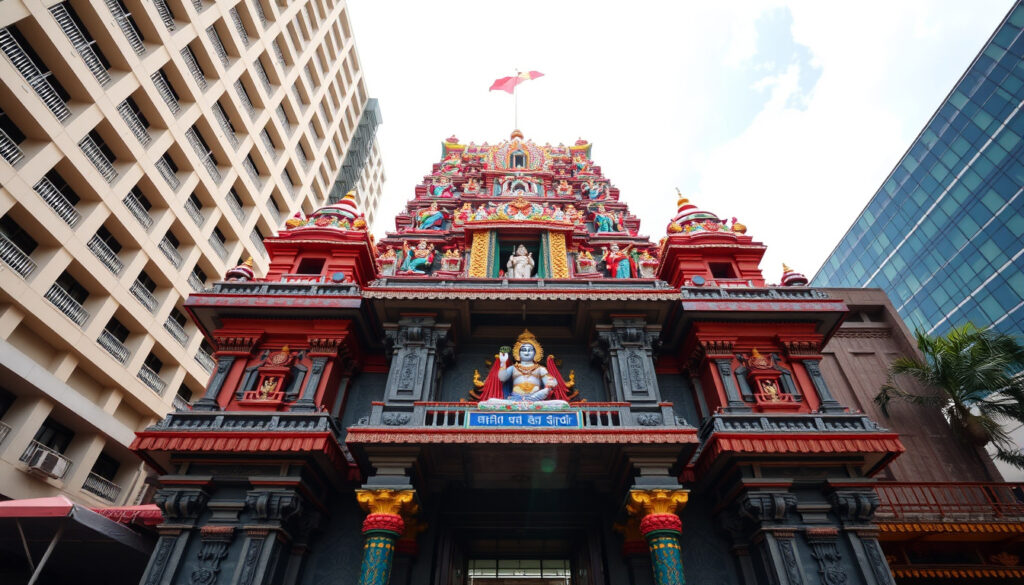
Anyone who has wandered through the colourful streets of Chinatown may have noticed the towering gopuram of Sri Mariamman Temple, a striking landmark that has been there since 1827. It is Singapore’s oldest Hindu temple, and its daily rhythm of worship still anchors the Tamil community.
Founded: 1827 · Location: 244 South Bridge Road, Chinatown, Singapore · Status: Oldest Hindu temple in Singapore · Architecture: Dravidian style · Managing body: Hindu Endowments Board (HEB) · Admission: Free
Quick snapshot
- Oldest Hindu temple in Singapore (The Straits Times (leading Singapore daily))
- Founded 1827 by Indian settlers (Sri Mariamman Temple official site (temple’s managing body))
- National Monument since 1973 (Sri Mariamman Temple official site) (The Straits Times (leading Singapore daily))
- Free admission, open daily 6:00am–12:00pm & 6:00pm–9:00pm (Sri Mariamman Temple official site) (The Straits Times (leading Singapore daily))
- Exact completion date of the original wooden structure is not precisely recorded (The Straits Times)
- The specific architect or builder of the original shrine remains unknown
- Early membership numbers of the founding community are not documented
- The exact number of renovations over the centuries is not fully documented
- The specific origins of the original wooden structure’s design are unknown
- 1827 – wooden shrine built by Indian settlers (Sri Mariamman Temple official site)
- 1830s–1840s – replaced with brick-and-stucco Dravidian structure (Wonderwall Singapore) (Sri Mariamman Temple official site)
- 1973 – gazetted as National Monument (Sri Mariamman Temple official site) (Sri Mariamman Temple official site)
- 2027 – 200th anniversary celebration planned (The Straits Times) (Sri Mariamman Temple official site)
- Year-long bicentennial celebration in 2027 (The Straits Times)
- Continued daily worship and visitor operations
- Potential renovation or conservation works ahead of the milestone
These key facts capture the temple’s vital statistics at a glance.
| Attribute | Value |
|---|---|
| Address | 244 South Bridge Road, Singapore 058793 |
| Year built | 1827 |
| Architectural style | Dravidian |
| Managing body | Hindu Endowments Board |
| Admission cost | Free |
| Morning hours | 6:00am – 12:00pm |
| Evening hours | 6:00pm – 9:00pm (Fri until 9:15pm) |
| National Monument status | Gazetted 1973 |
What is the history of Sri Mariamman Temple in Singapore?
Founding in 1827
- The temple was founded by Indian settlers who arrived in Singapore during the early 19th century (Sri Mariamman Temple official site (managing body)).
- A 2026 newspaper report notes that the temple will mark its 200th anniversary with a year-long celebration in 2027 (The Straits Times).
The founding community — mostly Tamil labourers and traders — needed a place to worship the goddess Mariamman, who protects against disease and brings rain. They built a simple wooden shrine on land granted by the British East India Company.
The original wooden structure
- The original structure was a modest wooden building (Wonderwall Singapore).
- No records survive of the exact completion date or the builder’s name (Sri Mariamman Temple official site).
What is known is that the shrine quickly became a focal point for the growing Hindu population. Within a decade, the wooden structure was replaced by a more permanent brick-and-stucco building.
Evolution into a stone temple
- During the 1830s–1840s the temple was rebuilt in the Dravidian style with brick and stucco (Wonderwall Singapore).
- The iconic gopuram (ornate entrance tower) was added in the 1850s (Sri Mariamman Temple official site).
The gopuram, covered in colourful sculptures of gods and goddesses, became the temple’s most recognisable feature. It rises above the South Bridge Road shophouses, signalling the presence of a sacred space in the heart of Chinatown.
National monument status
- The temple was gazetted as a National Monument on 6 July 1973 (Sri Mariamman Temple official site).
- It is one of the oldest National Monuments in Singapore, alongside the Thian Hock Keng Temple and the former City Hall (The Straits Times).
The temple has survived war, urban redevelopment, and shifting demographics to remain active. It is not a museum piece — it still holds daily poojas and major festivals, proving that heritage and living worship can coexist.
The temple’s 200-year arc from wooden shrine to gazetted monument shows how a single community space can anchor an entire ethnic group’s identity. For visitors, that continuity means they are stepping into a living tradition, not a preserved relic.
This continuity makes the temple a living monument rather than a static artifact.
Is the Sri Mariamman Temple free?
Admission charges
- Admission to Sri Mariamman Temple is free for all visitors (Singapore Spirit).
- No separate tourist entrance or ticketing fee (Singapore Spirit).
Free entry is standard for functioning Hindu temples in Singapore, but Sri Mariamman Temple also offers complimentary sarong wraps at the entrance for visitors who need them — a thoughtful touch that makes the temple genuinely accessible.
Donation practices
- Donations are welcome but not required (Sri Mariamman Temple official site).
- Visitors can purchase offerings (flowers, coconuts, prasadam) at the temple shop.
The temple relies on voluntary contributions from devotees and visitors. There is no pressure to give, and the experience is identical whether you donate or not.
Special event fees
- Some sources mention separate charges for photography or video permissions (Miles With Vibes).
- Special ceremonies or festivals may have associated costs for participation (e.g., offering a coconut during a pooja).
The trade-off: the temple is free to enter, but if you want to photograph the intricate sculptures or join a specific ritual, you may be asked to pay a small fee. That is standard practice across Singapore’s active temples.
What is the dress code for Sri Mariamman Temple Singapore?
Recommended attire
- Visitors should dress modestly, covering shoulders and knees (Singapore Spirit).
- Traditional Indian attire is common but not mandatory (Wonderwall Singapore).
Most visitors will be fine in long pants or a long skirt and a T-shirt that covers the shoulders. Sleeveless tops and shorts are discouraged.
Footwear rules
- Footwear must be removed before entering the inner hall or prayer areas (Singapore Spirit).
- Socks are allowed inside (Wonderwall Singapore).
There are shoe racks near the entrance. The temple courtyard is generally clean, but wearing socks can keep your feet comfortable on the cool stone floor.
Head coverings
- Head coverings are not required but are respectful for women (Singapore Spirit).
- Some women choose to cover their heads as a sign of reverence, but it is not enforced.
The pattern: the temple is lenient compared to some South Indian temples, but the standard rule applies — cover up, remove shoes, and be quiet inside the prayer hall.
Sarong wraps are reportedly provided at the entrance at no charge for visitors who need them (Singapore Spirit). This is a welcome backup if you show up underdressed, but don’t rely on it — bring your own modest clothing to be safe.
In summary, modest dress and bare feet are the main requirements.
What are the stories about Mariamman?
Mariamman as a rain goddess
- Mariamman is a Hindu goddess of rain, fertility, and healing (Sri Mariamman Temple official site).
- Her stories are mainly from Tamil folk tradition, not the classical Puranic canon (Sri Mariamman Temple official site).
Unlike the pan-Indian goddesses Durga or Parvati, Mariamman is a regional deity venerated in Tamil Nadu and among Tamil diaspora communities. She is often depicted with a trident and a bowl of healing water.
Connection to smallpox and healing
- She is particularly associated with protection from diseases like smallpox (Sri Mariamman Temple official site).
- Devotees believe she can cure fever, skin ailments, and other illnesses (Sri Mariamman Temple official site).
Historically, villages in South India would build small Mariamman temples on the outskirts as a quarantine measure during smallpox outbreaks. That protective role is still honoured today.
Mythological narratives
- One story says Mariamman emerged from the third eye of the god Shiva to destroy the demon Durgama (Sri Mariamman Temple official site).
- Another tradition connects her to the goddess Renuka, who was beheaded by her son Parashurama and later restored.
The catch: there is no single canonical version of Mariamman’s mythology. The stories vary by region and family tradition, which is typical for folk deities. What matters is her role as a protector who listens to everyday people.
Architectural specifications of Sri Mariamman Temple
Six details, one theme: the temple is a textbook example of South Indian Dravidian architecture adapted to Singapore’s tropical environment.
| Specification | Detail |
|---|---|
| Architectural style | Dravidian (South Indian) |
| Main deity | Goddess Mariamman |
| Construction material | Brick and stucco with later stone additions |
| Entrance tower (gopuram) | Ornate, multi-tiered with colourful sculptures of deities |
| Year of major stone rebuild | 1830s–1840s |
| Gopuram addition | 1850s |
| National Monument gazette | 1973 |
| Managing body | Hindu Endowments Board (HEB) |
| Address | 244 South Bridge Road, Singapore 058793 |
These specifications illustrate the temple’s Dravidian heritage and its adaptation to Singapore’s climate.
Timeline
- 1827 – Construction of a wooden shrine by Indian settlers along South Bridge Road (Sri Mariamman Temple official site).
- 1830s–1840s – Gradual replacement with a brick-and-stucco Dravidian-style structure (Wonderwall Singapore).
- 1850s – Addition of the gopuram (ornate entrance tower) (Sri Mariamman Temple official site).
- 1960s – Major renovation and expansion (Sri Mariamman Temple official site).
- 1973 – Gazetted as a National Monument of Singapore (Sri Mariamman Temple official site).
- 2027 – 200th anniversary celebration planned (The Straits Times).
The timeline underscores how a small immigrant shrine evolved into a state-protected icon.
Confirmed facts vs. what’s unclear
Confirmed facts
- Sri Mariamman Temple is the oldest Hindu temple in Singapore (The Straits Times).
- Founded in 1827 by Indian settlers (Sri Mariamman Temple official site).
- Admission is free (Singapore Spirit).
- Address: 244 South Bridge Road (Sri Mariamman Temple official site).
- Timings: 6:00am–12:00pm, 6:00pm–9:00pm (Sri Mariamman Temple official site).
What’s unclear
- Exact date of completion of the original wooden structure is not precisely recorded (Sri Mariamman Temple official site).
- The specific architect or builder of the original shrine is unknown.
- Early membership numbers of the founding community are not documented.
- The exact number of renovations over the centuries is not fully documented.
- The specific origins of the original wooden structure’s design are unknown.
This balance of known and unknown is typical for historic sites with limited early records.
What people say about the temple
“Sri Mariamman Temple has been a spiritual anchor for Singapore’s Tamil community since 1827. It is the oldest Hindu temple in the country and continues to serve as a vibrant centre for worship and cultural events.”
Sri Mariamman Temple official site (temple’s managing body)
“The temple’s gopuram is a masterpiece of Dravidian architecture, covered in intricate sculptures that tell stories from Hindu mythology. It is one of the most photographed landmarks in Chinatown.”
“For many Tamil Hindus in Singapore, Sri Mariamman Temple is the place where they first brought their children, held their weddings, and sought blessings during times of illness. It is a living link to their ancestral traditions.”
The Straits Times (Singapore’s leading daily)
The pattern: the temple is not just a tourist attraction — it is a functioning centre of faith that has adapted to the needs of a modern city-state while preserving its core rituals. For the Tamil Hindu community, the bicentennial in 2027 will be a moment of pride and reflection. For visitors, the temple offers a rare chance to witness a tradition that has remained unchanged for two centuries.
For anyone planning a trip to Chinatown, the choice is clear: step inside, respect the dress code, remove your shoes, and spend a few minutes absorbing the quiet devotion of a temple that has outlived empires.
singapore-spirit.com, explorebees.com, sgnewsdesk.com, de.wikipedia.org, mileswithvibes.com, en.wikipedia.org, tripadvisor.ca, tripoto.com, sreemahamariamman.org
Frequently asked questions
Can I take photos inside Sri Mariamman Temple?
Photography is generally allowed in the courtyard and main hall, but some sources note that a separate fee may be required for professional or video photography (Miles With Vibes). Always ask permission before photographing the priests or worshippers.
Are there any restrictions for visitors during festivals?
During major festivals like Theemithi (fire-walking ceremony) and Navaratri, the temple can be very crowded. Visitors are welcome but should follow instructions from temple staff. Some areas may be restricted to participants only.
How do I get to Sri Mariamman Temple by public transport?
The temple is located at 244 South Bridge Road in Chinatown. The nearest MRT stations are Chinatown (NE4/DT19) and Telok Ayer (DT18). Buses 2, 12, 33, 61, 143, 197, 970, and CT8 stop along South Bridge Road.
What are the nearest MRT stations to the temple?
Chinatown MRT station (North East Line and Downtown Line) is about a 5-minute walk away. Telok Ayer MRT station (Downtown Line) is also within walking distance.
Is the temple wheelchair accessible?
The temple has a flat entrance and a courtyard that is wheelchair-friendly. However, the inner sanctum may have steps. It is best to check with the temple staff in advance.
Are there any nearby attractions to visit after the temple?
Yes, the temple is in the heart of Chinatown. Nearby attractions include the Buddha Tooth Relic Temple, the Chinatown Street Market, the Maxwell Food Centre, and the Thian Hock Keng Temple. The Sri Mariamman Temple is often included in walking tours of the area.
These common questions cover most visitor concerns.
More related posts
 What Is a Commuter Bike? Guide to Choosing Your Daily Ride
 Stratum Skin & Surgery: Dr Tay Liang Kiat, Dermatologist
 WSQ Courses in Singapore for Foreigners: Eligibility and Costs
 When is Black Friday 2025? Dates, Deals & What to Know
 300 SGD to INR: Convert Singapore Dollars to Rupees
 Bigg Boss Tamil Season 9: Finalists, Voting & Eliminations
 Singapore Amulet Resale Lawsuit – No Documented Court Cases
 Addvalue Tech Share Price: Volatility and Investment Outlook
