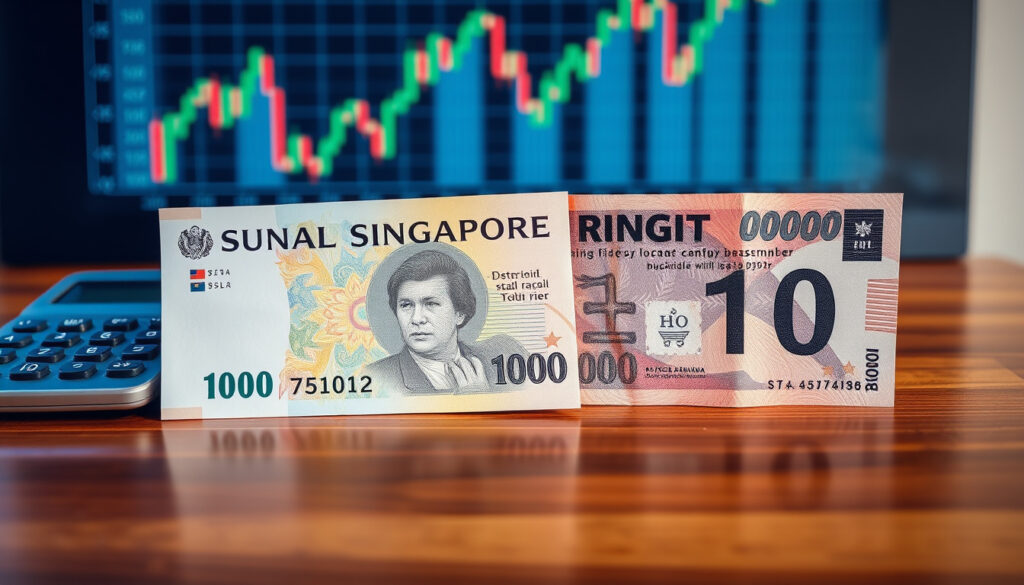
Malaysia to Singapore Currency: Exchange Rates & Cost Guide
Anyone who’s crossed the Causeway for a weekend knows the currency dance: ringgit in one pocket, Singapore dollars in the other – whether you’re a traveler, cross-border worker, or just comparing costs, getting the conversion right saves you real money. This guide covers the current mid-market rate (around 1 SGD = 3.09 MYR), where your ringgit actually works, and what that means for your wallet.
Mid-market exchange rate (approx): 1 SGD = 3.09 MYR / 1 MYR = 0.324 SGD · Cost of living difference: Singapore is approximately 4 times more expensive than Malaysia · Currency symbols: SGD (S$) and MYR (RM)
Quick snapshot
- Singapore dollar is the sole legal tender in Singapore – Monetary Authority of Singapore (central bank)
- Malaysian ringgit is not accepted for most payments in Singapore – Monetary Authority of Singapore (central bank) (Monetary Authority of Singapore (central bank))
- Exchange rates fluctuate constantly throughout the day – XE.com (currency converter)
- Exact exchange rate varies by provider and time of day – Revolut (digital banking)
- Highest MYR/SGD rate in recent period: 0.3272 on March 19, 2026 – Wise History (exchange rate data)
- Lowest MYR/SGD rate: 0.3057 on September 25, 2025 – Wise History (exchange rate data) (Wise History (exchange rate data))
- 6-month average MYR/SGD rate: 0.3163 – Wise History (exchange rate data) (Wise History (exchange rate data))
- Check live rates on Wise or XE before exchanging
- Compare bank vs moneychanger margins; moneychangers typically offer better rates (Wise)
- Consider a multi-currency card (e.g., Wise, Revolut) for borderless spending (Wise)
Here are key facts about the MYR‑SGD currency pair.
| Label | Value |
|---|---|
| Currency codes | SGD (Singapore dollar), MYR (Malaysian ringgit) – Instarem (financial services) |
| Typical exchange rate margin | Banks: 2-5% above mid-market; moneychangers: 1-3% – Wise (currency transfer service) |
| Legal tender in Singapore | Only SGD – Monetary Authority of Singapore (central bank) |
| Legal tender in Malaysia | Only MYR – Instarem (financial services) |
| Cost of living rank (Numbeo) | Singapore: 6th highest globally; Malaysia: 100th – Numbeo (cost-of-living database) |
How much is $1 Singapore in Malaysia?
At the mid-market rate, one Singapore dollar buys approximately 3.09 Malaysian ringgit. That’s the baseline you see on Google. But the rate you actually get depends on who you exchange with.
How much is RM100 in Singapore?
Using the inverse rate (1 MYR ≈ 0.324 SGD), RM100 converts to about SGD 32.40. XE.com (currency converter) and Wise (currency transfer service) both show this range. Banks and moneychangers add a margin, so expect slightly less.
How much is 1000 Singapore in Malaysia?
For 1,000 SGD, you’ll get roughly 3,090 MYR at the mid-market rate. OFX (foreign exchange services) reported a rate of 1 SGD = 3.103660 MYR on May 1, 2026, meaning 1,000 SGD would yield 3,103.66 MYR. The difference between mid-market and the actual rate you get can be 2-5% depending on the provider.
The implication: even small margins matter on large sums.
Can I pay with Malaysian ringgit in Singapore?
Short answer: no. The Monetary Authority of Singapore (MAS (central bank)) recognizes only the Singapore dollar as legal tender. Most retailers, restaurants, and transport will refuse ringgit outright. Some border-area shops near the Johor-Singapore crossing may accept ringgit, but at a poor exchange rate that eats into your buying power.
Is ringgit used in Singapore?
Ringgit is generally not accepted for everyday transactions. If you try to pay with MYR, you’ll likely be asked to convert first. A few convenience stores in the Woodlands or Tuas checkpoint area may offer an informal exchange, but the rate is almost always worse than what you’d get at a moneychanger.
Currency rules at Johor-Singapore border
There are no formal restrictions on carrying either currency across the border for personal use. However, you must declare cash amounts exceeding SGD 20,000 (or equivalent) when entering Singapore under MAS (central bank) rules. For daily travel, simply carry SGD for spending and MYR for your return to Malaysia.
Exchanging ringgit at a moneychanger before crossing the border typically gives you a better rate than using an ATM in Singapore or relying on impromptu shop acceptance.
The pattern: planning ahead with a moneychanger saves you the worst rates.
Which is cheaper, Malaysia or Singapore?
Singapore is significantly more expensive across nearly every category. According to Numbeo (cost-of-living database), consumer prices in Singapore are 3.3 times higher than in Malaysia. Rent is the biggest gap: 6.8 times higher. Groceries cost 2.5 times more, and restaurant prices are 3.6 times higher.
Is 7000 SGD a good salary in Singapore?
A monthly salary of SGD 7,000 is considered moderate. The average net salary in Singapore is around SGD 5,500, according to Numbeo (cost-of-living database). With SGD 7,000, a single person can live comfortably in a central area, but it’s not a “lavish” income. After rent, utilities, and food, you’ll likely save less than you would earning RM 15,000 in Malaysia.
Is earning 100K a year good in Singapore?
SGD 100,000 annually (about SGD 8,333/month) puts you well above the national average. It allows for comfortable housing, dining out, and regular travel, but still won’t make you feel rich given the city’s high cost of housing and cars. In Malaysia, the same purchasing power would require a much lower income.
Local purchasing power in Singapore is 2.1 times higher than in Malaysia (Numbeo (cost-of-living database)), meaning higher salaries offset some of the cost disadvantage. But for day-to-day spending, your ringgit won’t stretch as far across the border.
One pattern across all categories: accommodation is the biggest shock. Singapore’s rental market is among the world’s priciest, while Malaysia’s remains relatively affordable even in Kuala Lumpur.
Cost comparison: Singapore vs Malaysia
Six categories, one story: Singapore costs substantially more in every measurable area. Here’s the breakdown using Numbeo (cost-of-living database) data.
| Category | Malaysia (MYR) | Singapore (SGD) | Ratio (SG/MY) |
|---|---|---|---|
| Meal (inexpensive restaurant) | RM 15 | SGD 12 | 3.6× |
| Domestic beer (0.5L) | RM 12 | SGD 8 | 3.0× |
| Monthly rent (city center, 1-bed) | RM 1,800 | SGD 3,800 | 6.8× |
| Monthly public transport pass | RM 100 | SGD 120 | 5.4× |
| Utilities (monthly, 85m²) | RM 180 | SGD 170 | 4.2× |
| Milk (1L) | RM 8 | SGD 3.50 | 2.0× |
The gap is real, especially for rent and dining. A Malaysian earning RM 5,200 per month will find SGD 5,500 enough to live in Singapore, but with far less disposable income after rent.
How to exchange currency for travel between Malaysia and Singapore
Getting a fair deal on currency exchange doesn’t require wizardry. Follow these steps.
- Check the live mid-market rate on Wise or XE. This is your baseline. Any rate offered that’s more than 5% off is a bad deal.
- Compare moneychangers vs. banks. In Malaysia, moneychangers in shopping malls (e.g., Mid Valley, KL Sentral) often give better rates than banks. In Singapore, moneychangers at Lucky Plaza or Mustafa Centre are known for competitive rates.
- Use a multi-currency card like Wise or Revolut. These let you hold both MYR and SGD at real exchange rates, with low conversion fees.
- Avoid airport exchange counters – they typically add the highest margins (up to 8-10% above mid-market).
- For larger amounts (above SGD 1,000), consider transferring via Wise or an online platform instead of carrying cash. You’ll get closer to the mid-market rate.
For the reverse conversion, see our guide on 500 SGD to MYR. If you deal with Indonesian Rupiah, check our SGD to IDR rate guide.
Even if you use a multi-currency card, some ATM fees in Singapore can eat into savings. Always check if your card waives foreign transaction fees.
The lesson: compare fees and rates upfront to avoid surprises.
Confirmed facts
- Singapore dollar is the only legal tender in Singapore – MAS (central bank)
- Malaysian ringgit is not accepted for general payments
- Exchange rates fluctuate constantly – XE (currency converter)
- Cost of living in Singapore is ~3.3× higher than Malaysia – Numbeo (cost-of-living database)
What’s unclear
- Exact exchange rate varies by provider and time of day – Revolut (digital banking)
- Border-area acceptance policies may shift without notice
- Reported average salaries (RM 5,200 vs SGD 5,500) are medium-confidence estimates – Numbeo (cost-of-living database)
What the experts say
“The mid-market exchange rate is the rate you find on Google and is used by banks when trading among themselves. It is not the rate you get when exchanging currency.”
– Wise (currency transfer service)
“Only the Singapore dollar is legal tender in Singapore. Use of foreign currency for transactions is not permitted.”
– Monetary Authority of Singapore (central bank)
“Cost of living data shows Singapore is among the most expensive cities globally, while Malaysia ranks in the middle – a clear indicator for cross-border travelers.”
– Numbeo (cost-of-living database)
For anyone traveling from Malaysia to Singapore, the choice is clear: use SGD for all transactions, check live rates before exchanging, and avoid last-minute currency swaps at the border or airport. Your ringgit goes further when you plan ahead.
Frequently asked questions
How can I check the latest MYR to SGD exchange rate?
Use XE.com (currency converter) or Wise (currency transfer service) for live mid-market rates. For historical trends, Wise History (exchange rate data) provides charts.
Where should I exchange currency before crossing the border?
Moneychangers in major Malaysian malls (e.g., Mid Valley Megamall, KL Sentral) or Singapore’s Lucky Plaza generally offer better rates than banks or airport counters.
Are there ATMs in Singapore that dispense Malaysian ringgit?
No. ATMs in Singapore dispense only SGD. You can withdraw MYR from ATMs in Malaysia using your international card, but fees and exchange rate margins apply.
What is the best currency to carry for a short trip to Singapore?
Carry primarily Singapore dollars. A small amount of ringgit is useful for your return to Malaysia, but don’t bring excessive MYR into Singapore as it won’t be spendable.
Do Singapore malls accept credit cards from Malaysia?
Yes, most major retailers accept international Mastercard, Visa, and contactless payments. Your bank will convert MYR to SGD at its own rate, typically adding a foreign transaction fee of 1-3%.
How much cash can I carry between Malaysia and Singapore?
You must physically declare cash exceeding SGD 20,000 (or equivalent) when entering Singapore. Malaysia has no similar limit for MYR, but amounts over RM 30,000 may require declaration.
Is it better to convert MYR to SGD in Malaysia or Singapore?
Usually in Malaysia, because competition among moneychangers is higher, leading to tighter margins. Compare rates online before leaving and choose the best deal.
What are the typical charges for international money transfers?
Banks often charge 3-5% above the mid-market rate plus a fixed fee. Online services like Wise charge around 0.4-1% of the transfer amount, with no hidden markup.
More related posts
 Snapdragon 8 Elite Gen 5: Specs, Phones & Performance
 Cast of Workin’ Moms: Full List of Actors and Characters
 When Is Mother’s Day 2026 in Singapore
 IKEA Alexandra Opening Hours: Today, Sunday, Food & CNY
 Clinic Open Near Me – Find Open Clinics and Urgent Care Now
 HomeTeamNS Bukit Batok Chalet: West Villa Guide 2025
 A&A Works: Definition, Examples in Singapore Construction
 Final Destination: Bloodlines – Prequel, Cast, Release Date
