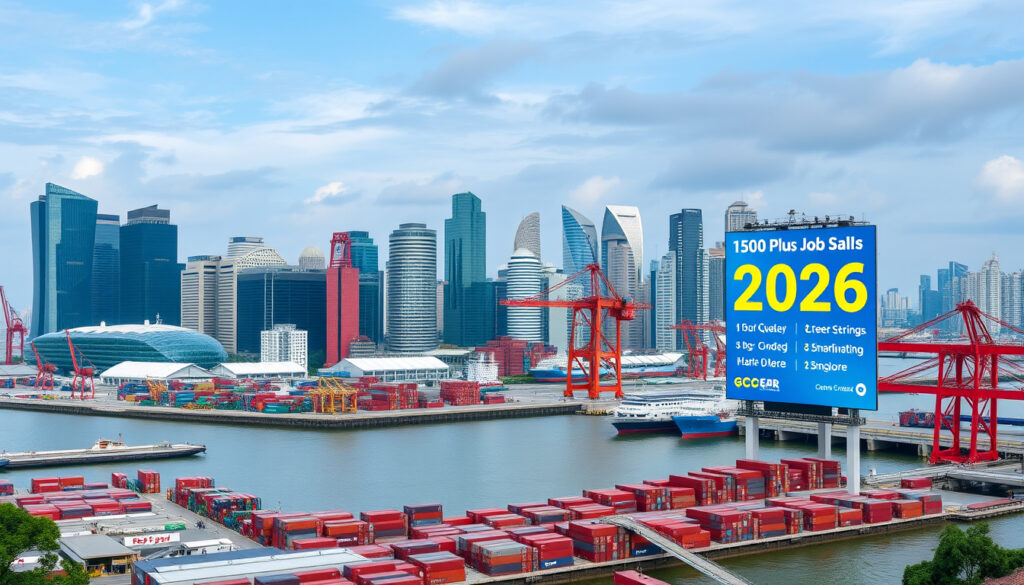
Operator Jobs in Singapore: 1500+ Openings & Salaries 2026
Singapore’s manufacturing sector is riding a wave of expansion heading into 2026, and that surge is translating into real opportunities on the factory floor. If you’ve been eyeing an operator job in Singapore—whether you’re local or coming from abroad—the market right now is unusually active, with more than 2,600 operator positions scattered across major job boards. Salaries for production operators typically land in the SGD 1,800–2,400 range, with shift allowances and overtime pushing total compensation notably higher.
Operator Jobs on Jobstreet: 1503 ·
Production Operator Jobs on Indeed: 112 ·
Operator Jobs on LinkedIn: 1,000+ ·
Production Operator Jobs on MyCareersFuture: 131 ·
General Production Operator Jobs on FastJobs: 6270
Quick snapshot
- Average production operator salary: SGD 2,979/month (Jooble Singapore)
- Entry-level: SGD 1,800–2,400/month (CoreStaff Singapore)
- LQS increases to SGD 1,800 effective July 1, 2026 (Ministry of Manpower Singapore)
- Exact 2026 salary projections without direct employer data
- Regional pay variations across Tuas, Woodlands, Pasir Panjang
- Age-adjusted EP and S Pass salary bands
- LQS rises to SGD 1,800 on July 1, 2026
- EP and S Pass salary thresholds increase January 2027
- Budget 2026 levy changes phased through 2027–2028
- Higher entry threshold for foreign worker quota eligibility
- Enhanced Progressive Wage Credit Scheme through 2028
- Continued manufacturing demand in northern zones
The table below consolidates key employment metrics and salary benchmarks for production operator roles across Singapore’s manufacturing sector.
| Metric | Value |
|---|---|
| Jobstreet Operator Listings | 1503 (April 2026) |
| Indeed Production Operator Jobs | 112 |
| LinkedIn Operator Openings | 1,000+ |
| MyCareersFuture Production Jobs | 131 |
| FastJobs Production Operators | 6270 |
| Average Salary (Jooble Singapore) | SGD 2,979/month |
| Entry-Level Salary (CoreStaff) | SGD 1,800/month |
| Experienced Operator Ceiling | SGD 2,400/month |
| LQS New Threshold (July 2026) | SGD 1,800/month |
| EP Minimum (General Sectors, Jan 2027) | SGD 6,000/month |
How much do operator jobs pay in Singapore?
Production operator salaries in Singapore cluster in a predictable band, though the total package often looks better than the base figure suggests. According to job market data from Jooble Singapore, the average production operator earns SGD 2,979 per month as of April 2026. The CoreStaff Singapore manufacturing salary guide puts the typical range at SGD 1,800–2,400 per month depending on experience level, with entry-level roles starting around SGD 1,800 and experienced operators topping out near SGD 2,400.
Operator Salary in Singapore (April, 2026) – Jobstreet
The gap between base salary and actual take-home widens when you factor in allowances. Shift allowances and overtime can add 20–30% to base pay for production operators, according to the CoreStaff Singapore manufacturing salary guide. A worker on SGD 2,000 base could realistically bring home SGD 2,400–2,600 with regular shift premiums and overtime hours—which many manufacturing roles actively offer.
“Our data shows production operator roles offering base salaries between SGD 1,800 and SGD 2,400, but when you add shift allowances and overtime, many workers see 20–30% more in their take-home pay.”
— CoreStaff Singapore Manufacturing Salary Guide
Simple female production Operator jobs in Singapore salary
Entry barriers for production operator roles are deliberately low. Most positions require no prior experience, with employers providing on-the-job training for career growth. Physically fit candidates able to handle packing, assembly, and equipment operation stand the best chance. The 5-day work week (Monday–Friday) is standard for most roles, though some facilities operate on rotating shifts.
For local candidates, the real question is not whether SGD 1,800–2,400 beats minimum wage—it does—but whether the physical demands and shift structure fit your situation. For employers, the July 2026 LQS increase means workers at or below the old SGD 1,600 floor no longer count toward your foreign worker quota.
Which job is in high demand in Singapore?
Manufacturing sector roles—production operators, machine operators, and warehouse staff—sit near the top of Singapore’s demand list heading into 2026. The SMU Academy analysis of in-demand roles identifies operator positions in manufacturing and logistics as growth categories, driven by the sector’s ongoing expansion and the government’s push to maintain domestic manufacturing capacity.
13 Most In-Demand Jobs in Singapore in 2026 | SMU Academy
The 60% dependency ratio ceiling for foreign workers in manufacturing keeps local hiring competitive. Employers actively recruiting production operators face constraints on how many foreign workers they can bring in, which means eligible local candidates face less competition for entry-level roles than they might expect. The sector’s levy structure—SGD 350 monthly for higher-skilled R1 workers and SGD 550 for basic-skilled R2 workers—further shapes hiring economics.
- Production operator roles classified as high-demand by SMU Academy analysis
- Manufacturing dependency ratio ceiling limits foreign worker supply
- Sector levies make local hiring economically attractive at the LQS floor
The implication: employers constrained by the foreign worker ceiling will compete more aggressively for local candidates at the entry level.
The combination of quota caps and levy costs creates a situation where local production operators are not fungible with foreign workers at arbitrary salary levels. Employers need to run the numbers on whether bringing in Work Permit holders (who have no fixed minimum salary but trigger levy obligations) makes sense versus hiring locally at the new LQS floor.
Can foreigners get a job in Singapore?
Foreign nationals can access operator-level roles in Singapore, but the pathway depends heavily on which work pass category applies. Work Permit holders fill many production operator positions, though they face no fixed minimum salary floor—employers must still pay levies and comply with sector-specific quota rules. S Pass and Employment Pass holders represent higher-skilled tiers with their own salary thresholds.
Operator job in Singapore for foreigners
The salary landscape shifts significantly for foreign workers. From January 2027, the Employment Pass minimum qualifying salary rises from SGD 5,600 to SGD 6,000 per month for general sectors (SGD 6,600 for Financial Services). S Pass minimums climb from SGD 3,300 to SGD 3,600 (SGD 4,000 for Financial Services). Work Permit holders have no fixed floor, but their presence triggers the sector dependency ceiling.
“Work Permit holders fill many production operator positions in Singapore’s manufacturing sector. While they have no fixed minimum salary floor, employers must pay levies and comply with sector-specific quota rules.”
— Immigration Consultant Singapore
How to get a job in Singapore: 8 steps – Wise
Foreign nationals pursuing EP passes must clear the COMPASS assessment, a points-based framework requiring at least 40 points. COMPASS evaluates salary, qualifications, employer workforce diversity, and local hiring support. All EP applications since September 2023 go through this assessment. The phased nature of the 2026 policy changes—salary thresholds increasing through 2027–2028—gives businesses time to adjust their workforce composition.
The July 2026 LQS increase to SGD 1,800 creates a quota recalculation risk: workers earning below that threshold no longer count toward a company’s foreign worker quota, forcing employers to either raise wages or reduce headcount. This dynamic could paradoxically benefit local workers at the margin by reducing competition from lower-paid foreign hires.
Which job is easy to get in Singapore?
Production operator positions rank among the more accessible factory-floor roles in Singapore’s manufacturing sector. Walk-in interviews remain common, particularly in industrial zones like Woodlands, Tuas, and Pasir Panjang. Entry requirements are modest: no formal certifications typically needed, though physical fitness and ability to perform manual work are standard expectations.
Production Operator walk in interview
Walk-in interview opportunities appear regularly across Singapore’s industrial zones. Employers hosting walk-ins typically conduct on-the-spot assessments of physical capability and basic comprehension, then offer positions the same day. MyCareersFuture.gov.sg lists government-verified positions with direct application options, adding a layer of legitimacy that purely commercial job boards cannot match.
Production Operator Woodlands Singapore job vacancy
The Woodlands industrial zone hosts a concentration of manufacturing and production facilities, making it a target area for operator job seekers. FastJobs shows 6,270 production operator listings across Singapore, with a significant portion clustered in northern zones. For candidates willing to commute or relocate near these facilities, the volume of available positions reduces the search friction considerably.
How to apply for production operator jobs in Singapore
Breaking into production operator roles in Singapore follows a relatively straightforward path, though the steps vary slightly depending on whether you’re applying through walk-in interviews or formal application processes.
Here are the steps to apply for production operator jobs in Singapore:
- Start with MyCareersFuture.gov.sg for government-verified listings, then expand to Jobstreet, Indeed, and FastJobs for broader coverage.
- Prepare a basic resume highlighting physical fitness, reliability, and willingness to work shifts.
- Many employers conduct brief interviews on-site, so dress appropriately and arrive early.
- For foreign nationals: your pathway depends on your work pass status. Work Permit holders already in Singapore can approach employers directly.
- Shift availability matters—operators who accept rotating shifts or overnight schedules tend to land positions faster.
- Factor in commute costs to industrial zones: Woodlands, Tuas, and Pasir Panjang are not centrally located.
Is $4000 a month a good salary in Singapore?
At SGD 4,000 per month, a production operator position sits above the typical salary band for this role—but the comparison depends on what benchmark you use. CoreStaff Singapore’s manufacturing salary guide shows average manufacturing salaries ranging from SGD 2,000 to SGD 4,500 per month depending on role, experience level, and industry segment. SGD 4,000 represents the upper-middle range for production operators specifically, though specialized machine operators or those in high-value manufacturing segments may earn more.
What is the basic salary in Singapore?
Singapore has no statutory minimum wage, but the LQS framework serves a similar function for local workers. Effective July 1, 2026, the LQS rises from SGD 1,600 to SGD 1,800 per month. For part-time workers, the minimum sits at SGD 10.50 per hour under the LQS framework. The Progressive Wage Credit Scheme, enhanced in 2026 and extended through 2028, helps employers manage higher wage costs for eligible lower-wage Singaporean employees.
Is $10,000 a good salary in Singapore?
SGD 10,000 per month places a worker well above typical production operator compensation. At this level, you’re looking at supervisory roles, specialized technical operators, or experienced production managers—not entry or mid-level operator positions. For context: EP minimum salary for general sectors rises to SGD 6,000 per month from January 2027, which sits below SGD 10,000. Workers earning SGD 10,000+ typically have significant experience, technical certifications, or management responsibilities.
The pattern: SGD 4,000 is above the operator ceiling but still below EP minimums for foreign professionals—meaning the salary sits in a transitional zone where local candidates with experience may negotiate above typical operator pay.
Upsides
- 1503+ active operator listings on Jobstreet alone; high volume across multiple platforms
- Entry-level positions require no prior experience; employers provide training
- Shift allowances and overtime can add 20–30% to base salary
- Walk-in interviews common; fast hiring timeline possible
- Progressive Wage Credit Scheme supports employers, reducing layoffs risk
- Manufacturing sector dependency ceiling protects local workers from total foreign replacement
Downsides
- Base salary band of SGD 1,800–2,400 is modest by Singapore standards
- Physical demands and shift requirements not suitable for all candidates
- LQS increase removes lower-paid locals from quota calculations
- Foreign nationals face high EP/S Pass salary thresholds, limiting options to Work Permit track
- Process sector R2 worker levies increasing under Budget 2026
- Regional concentration in industrial zones means commute challenges for many
Related reading: Shared Parental Leave Singapore · Incorporation of Company in Singapore
activpayroll.com, sg.indeed.com, newlandchase.com, glassdoor.sg, glassdoor.com, immigrationconsultant.sg, glassdoor.sg, kmerleone.com
Frequently asked questions
What part-time job can earn me $2000 in SG?
Part-time work at SGD 10.50 per hour (the LQS minimum) requires roughly 190 hours monthly to reach SGD 2,000—equivalent to nearly full-time hours. Most legitimate part-time roles offering SGD 2,000+ monthly involve either significant hour volumes or skilled positions (tutoring, freelance design, etc.) rather than entry-level factory work.
How to earn $100 a day in Singapore?
Earning SGD 100 per day translates to roughly SGD 2,200–2,500 per month on a standard schedule. For production operators on SGD 1,800–2,400 base salary, this typically requires overtime or shift allowances to bridge the gap. Some employers offer performance-based bonuses that can close this difference for reliable workers.
Is $20,000 SGD per month a good salary in Singapore?
SGD 20,000 monthly (SGD 240,000 annually) places a worker in Singapore’s upper income brackets. At this level, you’re looking at senior management, specialized professionals, or highly experienced technical specialists—not production operators. This salary level would represent an exceptional overpayment for standard operator roles.
Are there cleaner job vacancies in Singapore?
Cleaning roles exist across Singapore’s service and facilities management sector, though salary data specific to cleaning jobs was not covered in this analysis. For candidates interested in facilities roles alongside production work, companies often seek operators who can handle both production tasks and facility cleanliness standards.
What are simple female production operator jobs?
Production operator roles are not gender-restricted in Singapore. CoreStaff Singapore and Jooble data show candidates placed across all demographics. The main requirements are physical fitness, ability to perform manual tasks (packing, assembly, equipment operation), and willingness to work shifts. Some employers may have preferences based on facility-specific needs, but legally, roles must be open to qualified candidates regardless of gender.
More related posts
 Shared Parental Leave Singapore: 2026 Guide, Calculator & Claim
 Circle Internet (CRCL) Share Price: Stock Forecast & Analysis
 A&A Works: Definition, Examples in Singapore Construction
 Best Jurong Point Cake Shops & Halal Cake Options
 Burnley FC vs Liverpool FC: Prediction, Results & Highlights
 Convert MP4 to MP3: Free Online, Desktop & Mobile Guide
 Goh Chok Tong’s Son Jailed? Full Story of Goh Jin Hian
 Galaxy S5 to Buy – Prices, Places and Risks in 2025
