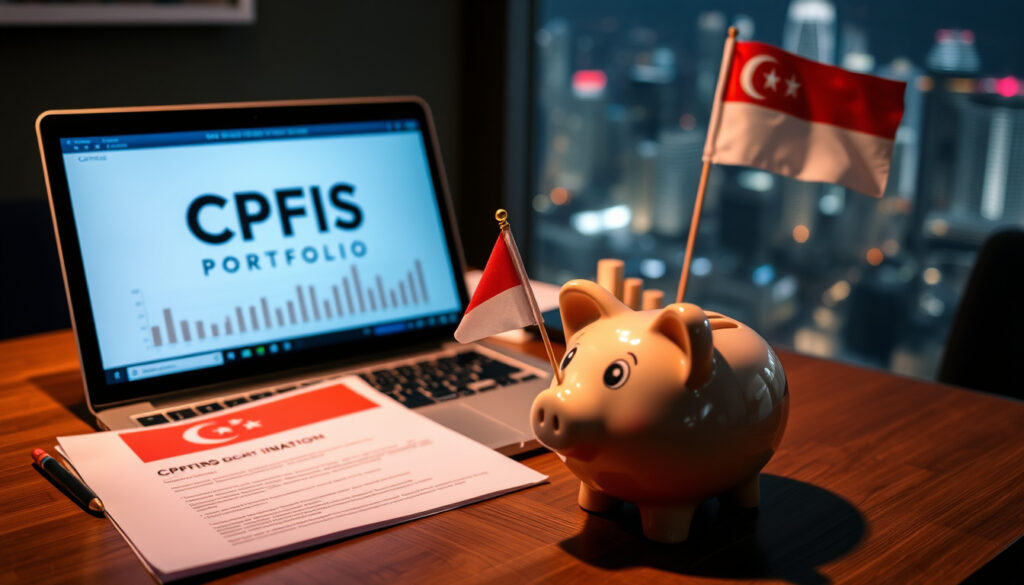
Singapore CPF Stocks Investment: How to Invest with CPFIS
If you’ve ever looked at your CPF statement and wondered whether the 2.5% interest from your Ordinary Account is really the best you can do, you’re not alone. Thousands of Singaporeans are exploring the CPF Investment Scheme (CPFIS) as a way to put their savings to work in the stock market.
CPF OA rate: 2.5% p.a. · CPF SA rate: 4.05% p.a. · Min OA balance: S$20,000 · Max stock allocation: 35% · Max gold allocation: 10% · Eligible stocks: Over 300
Quick snapshot
- CPFIS allows stock investment up to 35% of investible savings (CPF Board Official)
- Minimum OA balance of S$20,000 required (DBS CPF Investment Account page)
- CPF OA interest rate is 2.5% p.a.; SA rate is 4.05% p.a. (The Straits Times guide)
- Whether stock investments consistently beat CPF interest rates depends on market conditions (Yahoo Finance Singapore analysis)
- Impact of post-55 withdrawal rules on long-term returns is case-specific (Business Insider CPFIS explainer)
- CPFIS is an ongoing scheme with no fixed end date; members can invest anytime after meeting minimum balance (MAS regulation on CPFIS)
- Check eligibility and open a CPF Investment Account at DBS, UOB, or OCBC (UOB CPF Investment Account page)
- Review eligible stocks on SGX and place trades (SGX CPFIS list)
Six key facts define the CPFIS framework for stock investors. One pattern: the scheme balances opportunity with safety rails.
| Fact | Value | Source |
|---|---|---|
| CPFIS eligibility | Singapore citizens and PRs with CPF savings | CPF Board |
| Minimum OA balance | S$20,000 | CPF Board |
| Stock limit | 35% of investible savings | CPF Board |
| Gold limit | 10% of investible savings | CPF Board |
| Number of eligible stocks | Over 300 on SGX | SGX |
| Bank partners | DBS, UOB, OCBC | Bank portals |
Can I use CPF to invest in stocks?
Yes — the CPF Investment Scheme (CPFIS) is the official channel. It lets you invest Ordinary Account (OA) and Special Account (SA) savings in approved products, including stocks, unit trusts, bonds, and gold. The scheme is run by the CPF Board (Singapore’s retirement savings authority).
What is the CPF Investment Scheme (CPFIS)?
- CPFIS covers stocks, unit trusts, ETFs, bonds, Treasury Bills, annuities, and gold. Only SGX-listed stocks on the approved list are eligible (SGX CPFIS stock list).
- To participate, you must be at least 18 years old and not an undischarged bankrupt (CPF Board eligibility criteria).
Which CPF accounts can be used for stock investment?
- CPFIS-OA: Allows stock investment up to 35% of investible savings and gold up to 10% (DBS CPF Investment Account page).
- CPFIS-SA: Does NOT permit direct stock or gold investments. SA savings can go into bonds, Treasury Bills, annuities, and unit trusts (StashAway Singapore investment guide).
The implication: choosing the wrong account for your intended investment type means wasted effort. Match your account to your product first.
How much in CPF before I can invest?
The CPF Board sets minimum balances that must stay untouched. Only the excess above those floor amounts becomes “investible savings.”
Minimum OA balance requirement
- You need at least S$20,000 in your Ordinary Account before the surplus becomes eligible for investment (The Straits Times CPFIS guide).
Calculating investible savings
- For OA: investible savings = total OA balance minus S$20,000, plus any amounts previously withdrawn for investment or education (Business Insider CPFIS explainer).
- For SA: you must retain S$40,000; only the excess can be directed to approved non-stock products (MAS CPFIS regulatory overview).
The catch: the S$20,000 OA floor and S$40,000 SA floor are not optional — they lock up the first portion of your balance regardless of your investment plans.
How to invest with CPF?
- Open a CPF Investment Account — Available at DBS, UOB, or OCBC. No charges to open, but each bank has its own fee schedule (DBS CPF Investment Account page).
- Choose eligible stocks — The SGX maintains a list of over 300 stocks under CPFIS. Confirm your pick is on the list (SGX official list).
- Place trades — Use your bank’s online trading platform or a CPFIS-approved broker. The stock limit of 35% of investible savings applies per rule (UOB CPF Investment Account page).
If you exceed the 35% stock limit in your OA, the CPF Board may suspend your CPFIS and require you to liquidate positions. Track your allocation quarterly.
What this means: the three-step process is straightforward, but the ongoing allocation monitoring is where most investors slip up.
Is CPF stock a good long-term investment?
The promise of CPFIS is higher returns, but the risk is real. Comparing historical stock returns against CPF’s guaranteed rates reveals the trade-off.
Historical performance of CPFIS vs CPF interest rates
- CPF OA earns a floor of 2.5% p.a., SA earns 4.05% p.a. — guaranteed with no market risk (CPF Board official interest rates).
- The S&P 500 has historically averaged about 10% per year, but with years of double-digit losses (Yahoo Finance Singapore analysis).
- You can invest in S&P 500 through CPFIS by buying unit trusts that track the index (The Straits Times guide).
Risks of stock investing with CPF savings
- No CPF guarantee: losses reduce your retirement savings directly.
- The “7% rule” is a general stock market guideline — not specific to CPF — and should not be used as a return assumption (Business Insider CPFIS explainer).
Role of diversification
Spreading across stocks, bonds, and gold within CPFIS limits (bond/unit trust no cap, gold 10%) can reduce volatility while still aiming for returns above 2.5%.
Upsides
- Potential to earn more than 2.5% OA rate
- Access to 300+ SGX stocks
- Control over investment choices
Downsides
- Losses can reduce retirement sum
- 35% stock cap limits upside
- Fees from banks and brokers eat into returns
The pattern: the upside of CPFIS depends entirely on market timing and selection — neither of which the CPF Board guarantees. The downside is permanently reduced retirement savings.
What happen to CPF Investment after 55?
Upon reaching age 55, the CPF Board creates a Retirement Account. This changes how your CPFIS investments work.
- Your OA and SA savings (except for amounts already invested) are transferred to the Retirement Account (CPF Board scheme details).
- Existing investments can be kept or sold. If sold, proceeds go to the Retirement Account if needed for the Full Retirement Sum (The Straits Times guide).
- Withdrawals are limited to balances above the Full Retirement Sum (S$96,000 for 2024) (Business Insider CPFIS explainer).
The catch: Stock losses after 55 directly reduce the cash available for retirement payouts. Conservative positioning becomes more critical as you approach withdrawal age.
A 55-year-old with heavy stock exposure faces a double hit: market downturns shrink the Retirement Account, and the 35% stock cap limits recovery potential. Rebalancing toward bonds or T-bills may be prudent in the decade before 55.
The implication: age 55 is not a deadline to exit stocks, but it is a signal to reduce risk. Your investment timeline after 55 is shorter, and recovery from losses is harder.
Clarity check: What we know vs what remains uncertain
Confirmed facts
- CPFIS allows stock investment up to 35% of investible savings (CPF Board)
- Minimum OA balance of S$20,000 required (DBS CPF Investment Account page)
- CPF OA rate is 2.5% p.a.; SA rate is 4.05% p.a. (The Straits Times guide)
What remains unclear
- Whether stock investments consistently beat CPF interest rates over long periods depends on market conditions (Yahoo Finance Singapore analysis)
- Impact of post-55 withdrawal rules on long-term returns is case-specific (Business Insider CPFIS explainer)
- Exact effect of bank fees and brokerage charges on net returns over long investment horizons
The pattern: what is confirmed are the rules. What remains unclear is whether those rules produce a better outcome than doing nothing — that depends entirely on your choices and market conditions.
“In addition, you can only invest up to 35% and 10% of your investible savings in stocks and gold, also known as the stock and gold limits.”
CPF Board, Investing your CPF savings
“CPFIS-SA is more restricted: you cannot invest in stocks or gold products, but you can invest in bonds, Treasury Bills, annuities, and unit trusts.”
StashAway Singapore, Complete guide to CPF Investment Scheme
For the average Singaporean with CPF savings above S$20,000 in OA, the decision to invest in stocks comes down to a single bet: can you consistently outperform 2.5% after fees and without losing sleep over volatility? The CPFIS gives you the tool, but the market does not guarantee the result. For those under 40 with a high risk appetite, the historical edge of stocks over bonds and cash may justify the stock limit dance. For those closer to 55, the safer path is to let the 4.05% SA rate compound untouched.
Related reading: CPF interest rates explained · CPF retirement planning guide · CPF Investment Scheme overview · CPF withdrawal rules after 55
For those looking to start, the CPF Investment Scheme provides a comprehensive guide to using CPF savings for stock investments.
Frequently asked questions
Can I invest 100% of my CPF in stocks?
No. The CPFIS limits stock investment to 35% of your investible OA savings. The remaining 65% must go into less volatile products such as bonds, unit trusts, or T-bills.
What happens if my stock investment loses money?
You bear the full loss. CPF does not guarantee investment returns. Losses reduce the amount available for retirement income.
Can I use CPF to buy REITs?
Yes, if the REIT is listed on SGX and appears on the CPFIS eligible stock list. Many Singapore REITs qualify.
Is it better to invest CPF in stocks or keep in SA?
For most people, the 4.05% SA rate offers a risk-free return that beats the historical return of many portfolios after fees. Stock investing through CPFIS is best considered only if you have a long horizon and a high risk tolerance.
How do I transfer CPF savings to my investment account?
You do not transfer directly. First open a CPF Investment Account at DBS, UOB, or OCBC. Then the bank will deduct the investment amount from your CPF account when you place a trade.
Are there fees for using CPFIS?
Yes. Banks charge annual service fees (typically S$2–S$10 per month), transaction fees, and custodian fees. These vary by bank. Check DBS, UOB, and OCBC fee schedules.
Can I change my CPF investment allocation later?
Yes. You can sell investments and buy different eligible products. The proceeds must be used within CPFIS or will be returned to your CPF account if no longer investing.
More related posts
 Blue Line MRT Map: Bangkok’s 43 Stations & Fares 2024
 Narita Airport to Tokyo: Compare Trains, Buses, Taxis & Costs
 Admin or Office Jobs in Ireland: Dublin Openings & Salaries
 Titanic Immersive Voyage Singapore Reviews – Honest Ratings and Tips
 Best Trading Platform for Beginners in Singapore 2025
 Arsenal Latest Transfer News: Rumors & Source Credibility
 Convert MP4 to MP3: Free Online, Desktop & Mobile Guide
 IT Show 2025 Brochure: Dates, Download & Deals in Singapore
