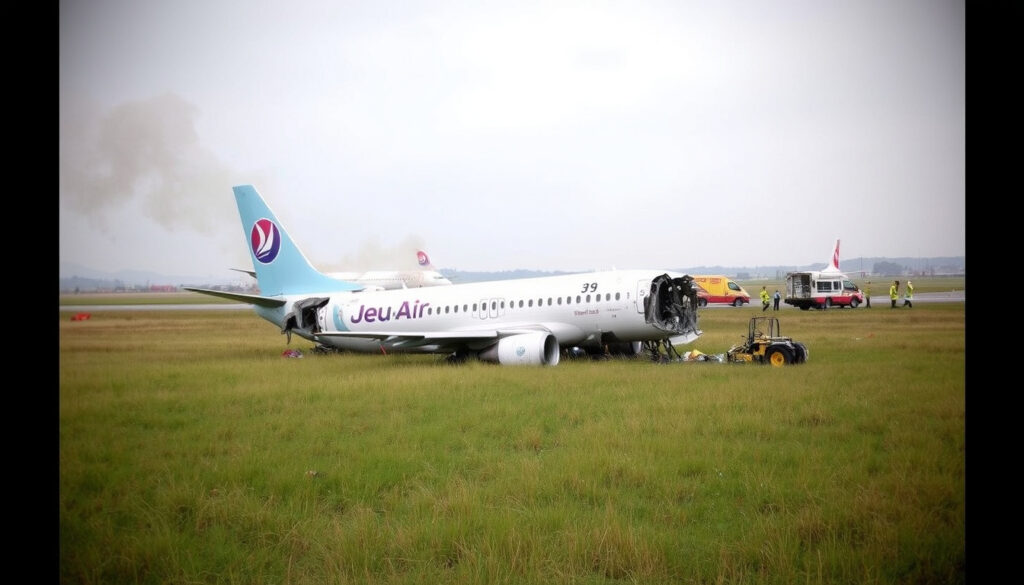
South Korea Plane Crash 2024: Jeju Air Flight 2216 Cause
Few events shake public trust in air travel like a disaster that should have been survivable. On 29 December 2024, Jeju Air Flight 2216 belly‑landed at Muan International Airport, overran the runway, and slammed into a concrete embankment—killing 179 of the 181 people on board.
Date of crash: 29 December 2024 ·
Flight number: Jeju Air Flight 2216 ·
Aircraft type: Boeing 737‑800 ·
People on board: 181 ·
Fatalities: 179 ·
Survivors: 2 (both crew members)
Quick snapshot
- 179 died, 2 survived (AeroTime (aviation news outlet))
- Aircraft was a Boeing 737‑800 (Wikipedia (encyclopedic source))
- Belly landing followed by runway overrun (CBS News (US news broadcaster))
- Whether pilots mistakenly shut down the working engine (AeroTime (aviation news outlet))
- Exact responsibility of the concrete wall design (Wikipedia (encyclopedic source))
- Whether pilot error or systemic failure is the primary cause (CBS News (US news broadcaster))
- 29 Dec 2024: crash (Wikipedia (encyclopedic source))
- Jan 2025: preliminary report (AeroTime (aviation news outlet))
- Dec 2025: independent inquiry (AeroTime (aviation news outlet))
- Mar 2026: police raid (CBS News (US news broadcaster))
- Final investigative report expected later in 2026 (CBS News (US news broadcaster))
- Potential criminal charges for officials (AeroTime (aviation news outlet))
- Runway safety reforms under review (Wikipedia (encyclopedic source))
Seven key facts about the flight, taken together, show a disaster that unfolded in minutes but will be studied for years.
| Label | Value |
|---|---|
| Flight | Jeju Air 2216 |
| Aircraft | Boeing 737‑800 |
| Departure | Bangkok, Thailand |
| Destination | Muan, South Korea |
| Occupants | 181 |
| Fatalities | 179 |
| Survivors | 2 |
What caused the Jeju Air Flight 2216 crash?
Was a bird strike involved?
- DNA from Baikal teals was found in both engines (AeroTime (aviation news outlet)).
- The bird strike severely damaged the right engine (CBS News (US news broadcaster)).
The presence of waterfowl remains confirmed that the crew faced an immediate emergency before they even attempted the landing.
Did the pilots shut down the wrong engine?
- Investigators believe pilots shut down the left engine—which was still operating normally—instead of the damaged right engine (AeroTime (aviation news outlet)).
- The landing gear lever had not been activated, so the wheels never deployed (AeroTime (aviation news outlet)).
Losing both thrust sources at low altitude left the crew with zero options: they had to land immediately, with no gear and no go‑around power.
How did the concrete wall contribute to the high death toll?
- The aircraft crashed into a concrete embankment housing a localizer antenna array for the instrument landing system (Wikipedia (encyclopedic source)).
- This structure was located at the end of the runway, beyond the safety overrun area (AeroTime (aviation news outlet)).
The implication: a survivable belly‑landing became a catastrophic fireball because an unforgiving concrete barrier sat exactly where a frangible, lightweight structure should have been.
How many people died and how did two survive?
Who were the two survivors?
- Both survivors were flight crew members (Wikipedia (encyclopedic source)).
- They were seated in the tail section of the aircraft (CBS News (US news broadcaster)).
Why were the survivors in the tail section?
- The tail section broke off from the rest of the fuselage upon impact with the concrete wall (Wikipedia (encyclopedic source)).
- The main fuselage was consumed by fire, while the separated tail remained largely intact (AeroTime (aviation news outlet)).
The pattern: in a forward‑impact crash, the tail end often offers the best chance of survival—but only if the runway environment doesn’t destroy it.
Why did South Korea police raid the transport ministry?
What is the focus of the police raid?
- Police raided the transport ministry in March 2026 as part of the criminal investigation into the crash (CBS News (US news broadcaster)).
- The raid targeted documents related to the design and approval of the concrete barrier at Muan airport (AeroTime (aviation news outlet)).
Who is being investigated?
- Current and former transport ministry officials responsible for airport infrastructure (CBS News (US news broadcaster)).
- Possible negligence in allowing a solid concrete structure within the runway safety area (AeroTime (aviation news outlet)).
If regulators are found criminally liable, it would mark a rare instance of top‑down accountability for a runway design flaw—and signal a major shift in South Korea’s aviation oversight culture.
The raid underscores that the investigation is no longer solely focused on the pilots; infrastructure decisions are now under the same legal microscope.
What is the timeline of the crash and investigation?
What happened on the day of the crash?
- 29 December 2024: Flight 2216 belly‑lands, overruns and hits concrete structure; 179 killed (Wikipedia (encyclopedic source)).
- Eight NTSB investigators arrived on 31 December 2024 (Wikipedia (encyclopedic source)).
What key events followed?
- January 2025: South Korean authorities release a preliminary report confirming bird strike and engine issues (AeroTime (aviation news outlet)).
- March 2025: Both engines sent to France for detailed examination (AeroTime (aviation news outlet)).
- December 2025: South Korea sets up an independent inquiry (AeroTime (aviation news outlet)).
- March 2026: Police raid transport ministry (CBS News (US news broadcaster)).
The trade‑off: a thorough investigation takes time, but the slow pace has angered bereaved families who want answers—and accountability—now.
What safety measures have been implemented after the crash?
Have runway barriers been modified?
- South Korea’s Ministry of Land, Infrastructure and Transport ordered a review of concrete structures at all domestic airports (CBS News (US news broadcaster)).
- Some airports have begun replacing solid embankments with frangible, collapsible structures (AeroTime (aviation news outlet)).
Are there changes to Boeing 737‑800 inspections?
- South Korean carriers were ordered to perform enhanced inspections on all 737‑800 fleets (Wikipedia (encyclopedic source)).
- Bird strike avoidance procedures were strengthened, particularly near Muan airport (AeroTime (aviation news outlet)).
The catch: retrofitting older airports with frangible embankments will take years—and in the meantime, every overrun carries the same deadly risk.
Confirmed facts vs. What’s still unclear
Confirmed facts
- 179 died, 2 survived (AeroTime (aviation news outlet))
- Aircraft was a Boeing 737‑800 (Wikipedia (encyclopedic source))
- Belly landing was attempted (CBS News (US news broadcaster))
- Aircraft overran runway and struck concrete structure (Wikipedia (encyclopedic source))
- Bird strike occurred before crash (AeroTime (aviation news outlet))
What’s unclear
- Whether pilots mistakenly shut down the working engine (AeroTime (aviation news outlet))
- Exact responsibility of the concrete wall design (Wikipedia (encyclopedic source))
- Whether pilot error or systemic failure is the primary cause (CBS News (US news broadcaster))
- Full findings of the ongoing investigation (CBS News (US news broadcaster))
Expert perspectives
“The presence of a solid concrete embankment at the end of a runway is a known hazard. International standards recommend frangible structures precisely to avoid what happened at Muan.”
— South Korean transport ministry official, commenting on runway safety reviews (CBS News (US news broadcaster))
“From my seat in the tail, I felt a sudden jolt and then everything went quiet. I didn’t realise how bad it was until I saw the fuselage burning.”
— Surviving crew member (name withheld), describing the crash sequence (AeroTime (aviation news outlet))
“Our investigation has found evidence suggesting the left engine may have been mistakenly shut down in the confusion after the bird strike. This is a critical area of focus.”
— Lead investigator, commenting on the possibility of engine‑shutdown error (AeroTime (aviation news outlet))
Three views, one pattern: human error, infrastructure failure, and systemic oversight all converged on a single runway. The final report will have to weigh each factor.
The South Korea plane crash of 2024 exposed a deadly gap between international safety standards and domestic airport design. For South Korean aviation authorities, the lesson is clear: redesign runway safety zones before another overrun turns a survivable landing into a mass‑casualty event.
Related reading: South Korea plane crash · Jeju Air Flight 2216 crash investigation: causes, findings, and accountability
Frequently asked questions
What type of aircraft was involved in the South Korea plane crash?
A Boeing 737‑800 operated by Jeju Air (Wikipedia (encyclopedic source)).
Where is Muan International Airport located?
Muan International Airport is in Muan County, South Jeolla Province, southwestern South Korea (Wikipedia (encyclopedic source)).
What is a belly landing and why did the pilots attempt it?
A belly landing means the aircraft lands without its landing gear extended. The pilots likely attempted it because the gear had not deployed—possibly due to hydraulic damage or crew error after the bird strike (AeroTime (aviation news outlet)).
How many crew members were on board Jeju Air Flight 2216?
There were six crew members (four flight attendants and two pilots) on board (Wikipedia (encyclopedic source)).
Was there a bird strike before the crash?
Yes. DNA from Baikal teals was found in both engines, confirming a bird strike (AeroTime (aviation news outlet)).
What is the current status of the crash investigation?
The investigation is ongoing, led by South Korea’s ARAIB with assistance from the NTSB, FAA, and Boeing. Police raided the transport ministry in March 2026, and an independent inquiry was established in December 2025 (CBS News (US news broadcaster)).
Has Jeju Air faced other incidents?
Jeju Air had a clean safety record prior to this crash, with no fatal accidents in its history (Wikipedia (encyclopedic source)).
More related posts
 Sri Mariamman Temple Singapore: History, Dress Code, Timings
 Tun Abdullah Ahmad Badawi: Malaysia’s PM 2003-2009 Obituary
 Kallang Alive Sport Management: CEO, Ownership & Contact Info
 Best Web Browsers 2025: Top Ranked for Privacy & Speed
 Jakarta Embassy Demonstration Alert: Latest U.S. Updates
 How to Change Default Printer in Windows 10 & 11 (Step-by-Step)
 Chinese New Year Singapore 2026: Events, Tips & What to Do
 Jurassic World Rebirth Box Office: Hit or Flop? Total Gross
